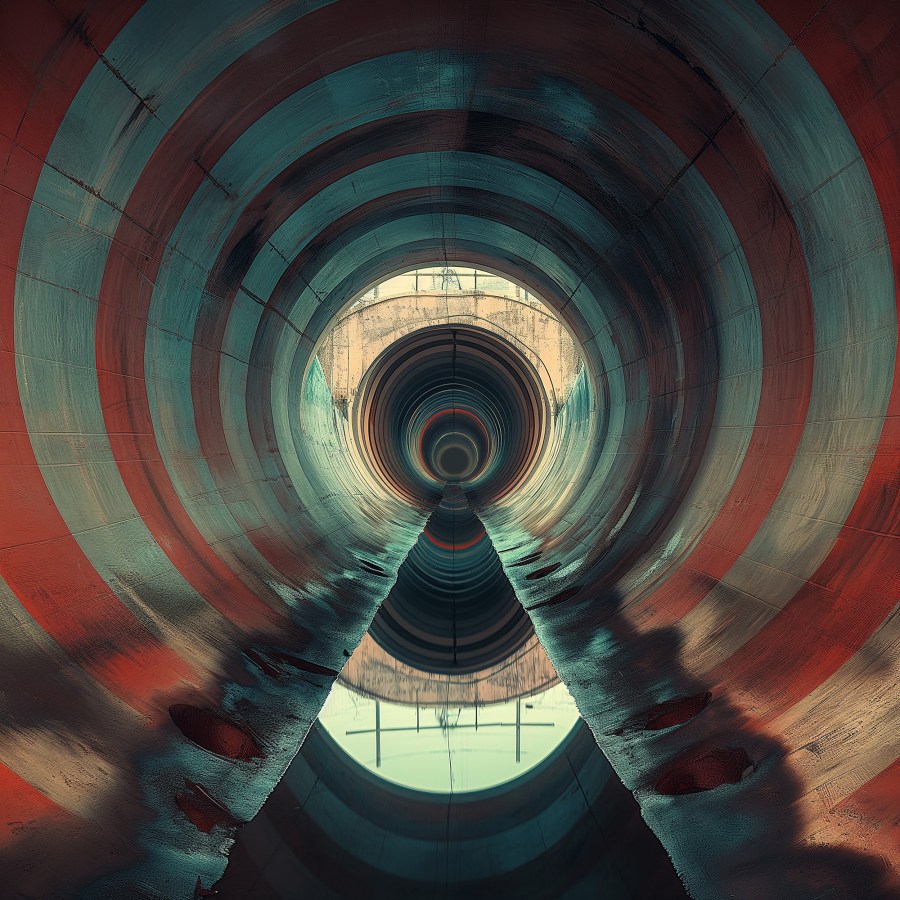
The series Zones de latence explores mental architecture as a perceptual transition space. Through circular tunnels, concentric structures and deep central perspectives, these images construct environments where the gaze is gradually drawn toward a vanishing point. The repetition of forms and reflections creates a suspended temporality, close to a sense of inhabited silence.
The series develops the idea of a traversal of the image toward emptiness. Architectural circles, perspective lines and reflective surfaces act as perceptual thresholds: the further the eye moves into the image, the more the structure seems to dissolve, opening onto an indeterminate space situated between real architecture, mental projection and visual uncertainty.
Each work is created from a photographic base digitally reworked. Artificial intelligence is used as a tool for formal exploration and generation, before the image is recomposed and finalized manually in Photoshop. This hybrid process between photography, algorithm and artistic intervention allows the creation of mental architectures, where space becomes a perceptual experience rather than a clearly identifiable place.
This research extends certain reflections developed in the series Architecture du silence, where the image explores the relationship between space, light and contemplation, as well as in Portraits de Famille – Rémanences, where the image acts as a reconstructed visual memory.
In Zones de latence, architecture becomes a structure of passage: an intermediate space where the gaze progressively crosses the form to reach a point of dark density, close to a meditative void.
This approach resonates with contemporary research on the perception of space and light, such as the work of James Turrell
https://jamesturrell.com
or experiments on immersive environments developed by the MIT Media Lab
https://www.media.mit.edu


Mental architectures where perspective becomes a slow journey toward a meditative void.